


Ahwatukee Market Report · July 2026
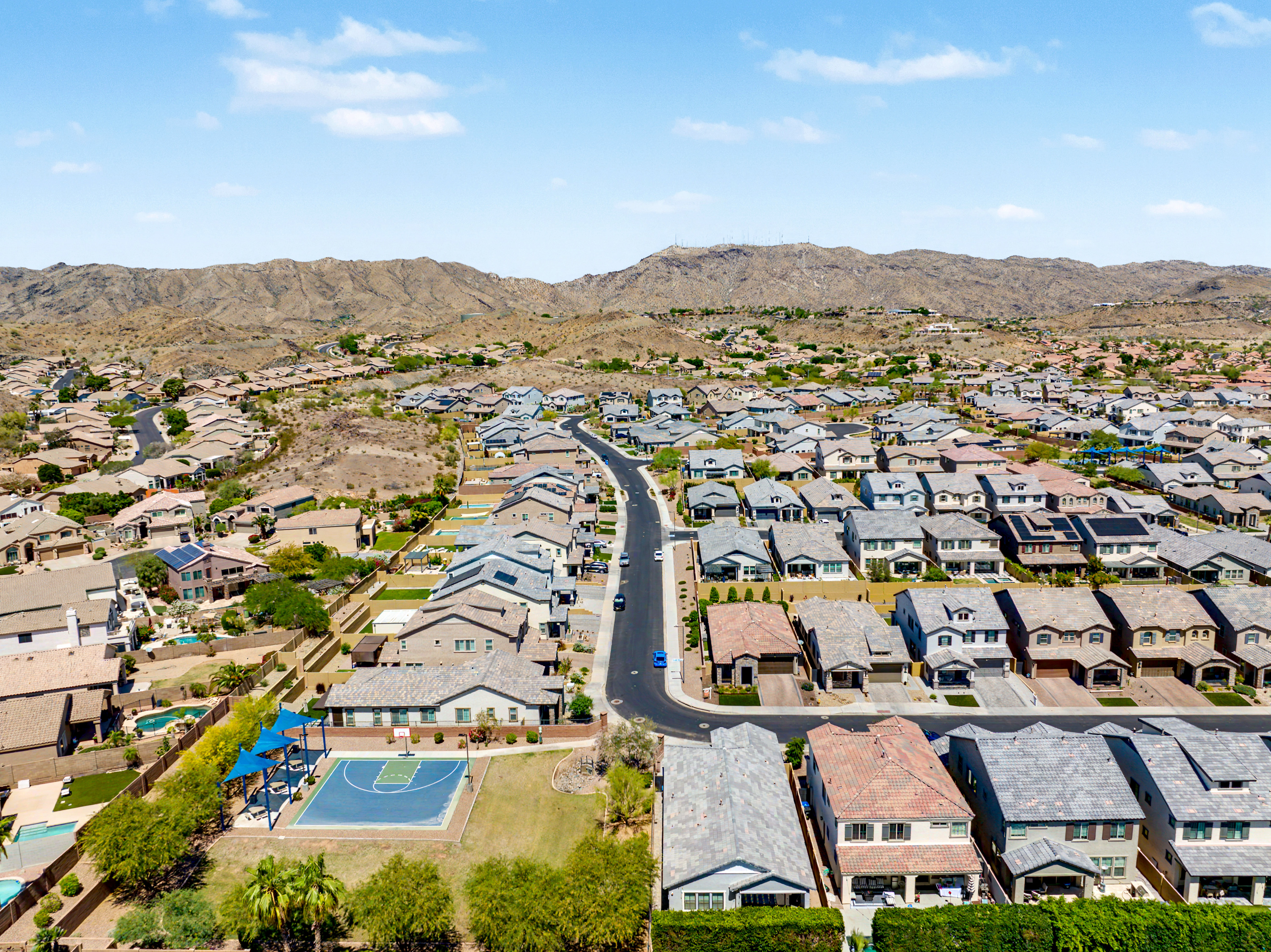
If you own a home in Ahwatukee, the first half of 2026 probably left you with mixed signals. National headlines say home prices have gone flat. Your neighbor's house sold in three weeks. A friend in Chandler had to offer closing-cost credits to get a deal done. So which is it?
All of it, actually — and the details matter. We went through the mid-year numbers for 85044, 85045 and 85048, checked them against Valley-wide and national data, and linked every figure to its source so you can verify anything in this report yourself. Here's what the first half of 2026 actually looked like in Ahwatukee, and what it means depending on where you sit: thinking of selling, sizing up a move, weighing a refinance, or simply keeping an eye on your biggest asset.
Ahwatukee by the Numbers: Mid-2026
Per MLS statistics for May 2026 (FlexMLS, reported June 2026), Ahwatukee's single-family market posted:
Eighty-five single-family homes closed in May — nearly identical to last year's 87 — with an average sale price of $617,064. Five closings topped $1 million, led by a 3,818-square-foot home in 85044 that sold for $1.3 million (MLS data via Swee Ng, HomeSmart).
Notice the tension inside those numbers. The median price rose 4.6%, yet price per square foot fell about 7%. Homes are selling, but at 60 days on market, they're not flying. Read together, the data describes a market where values are holding but buyers have become selective — larger and better-kept homes are driving the median up while negotiation compresses the price of everything else.
ZIP by ZIP: 85044, 85045 and 85048
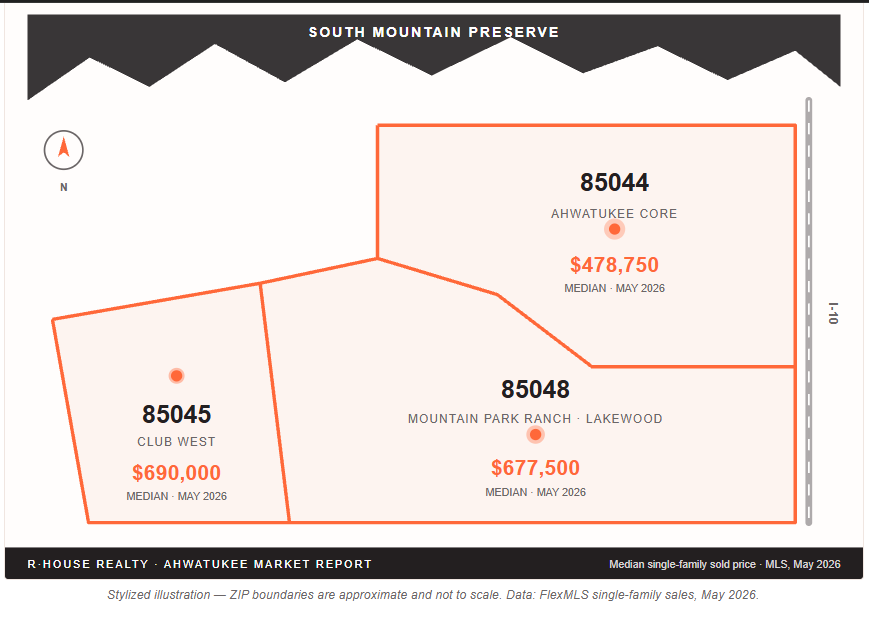
Ahwatukee is really three markets sharing one name. The May 2026 single-family figures (MLS data):
| ZIP Code | Median Sold Price | Average Sold Price |
|---|---|---|
| 85044 — Ahwatukee's core; highest volume, broadest price range | $478,750 | $541,376 |
| 85045 — Club West area; larger lots, newer construction | $690,000 | $729,500 |
| 85048 — Mountain Park Ranch, Lakewood, golf communities | $677,500 | $669,732 |
The pattern behind the table is durable: 85044's volume and range keep its median lower, while 85045 and 85048 — Club West, Mountain Park Ranch, Lakewood and the communities backing South Mountain Preserve — hold premiums near $700,000, supported by lot sizes, views and the Kyrene school district, whose local elementary schools rate 8–9 out of 10 on GreatSchools.
The Valley Context: Negotiation Is Back
Greater Phoenix has spent the past two years normalizing, and mid-2026 finds it balanced with a tilt toward buyers. The Cromford Report's demand-to-supply index — where 100 means balance — sits near 80, according to senior housing analyst Tina Tamboer in AZ Big Media's 2026 market outlook. Her framing is worth quoting in full:
"When we say it's a buyer's market, I don't want people to freak out. It's not the kind of buyer's market we saw in 2008. This is a market where buyers can actually negotiate again. That's not a bad thing." — Tina Tamboer, Senior Housing Analyst, The Cromford Report, via AZ Big Media
What negotiation looks like in practice: more than half of Valley transactions between $200,000 and $600,000 now include seller concessions — closing-cost help, rate buydowns, repair credits — per the same Cromford analysis. Tamboer also notes pockets of real softness: some mid-tier Valley neighborhoods remain 10–15% below their pandemic peaks, and condos have struggled where single-family homes offer more space for similar money.
So why aren't prices falling harder? Supply. Nationally, roughly 80% of mortgage holders carry rates below 5% and have little incentive to trade them away — the "lock-in effect" (AZ Big Media). Locally, that effect is amplified by geography: Ahwatukee is built out against South Mountain Preserve, and new listings fell 11.2% year over year in May (MLS data). Scarce supply is the quiet force under Ahwatukee's values.
The National Picture — and Why Ahwatukee Diverges
Nationally, the market is grinding sideways at record price levels. The National Association of Realtors reported the median existing-home price hit an all-time high of $440,600 in June 2026, up 1.8% year over year — the 36th straight month of annual gains — even as sales dipped 2.4% from May. NAR chief economist Lawrence Yun attributes the choppiness to affordability: "The back-and-forth in monthly home sales activity, driven by mild fluctuations in mortgage rates, shows how sensitive home buyers are to affordability conditions."
Forecasters expect little movement from here. Zillow's June 2026 forecast projects national home values to rise just 0.1% across 2026 — revised down from earlier estimates — with rising inventory keeping a lid on growth. Redfin's outlook lands in the same neighborhood at roughly 1%, calling it a gradual reset rather than a correction.
Rates and Refinancing: The Mid-6s Reality
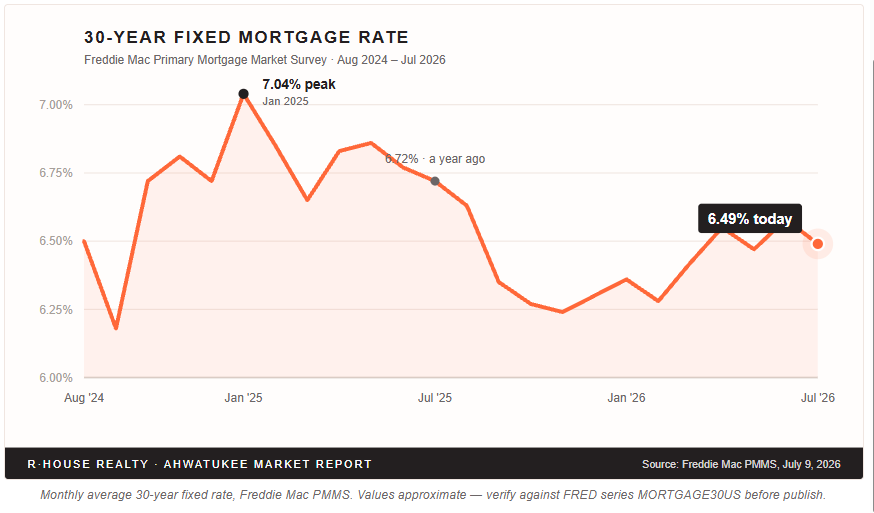
The 30-year fixed averaged 6.49% in Freddie Mac's July 9, 2026 survey, down from 6.72% a year earlier. Rates have spent most of 2026 oscillating in the low-to-mid 6s — and per Tamboer, that stability matters more than the level: buyers move when they trust today's rate will still be there tomorrow (AZ Big Media).
Refinancing has quietly come back to life. Refinance applications were running about 20% ahead of last year's pace in June, per Mortgage Bankers Association survey data, and the refi share of all mortgage applications has swung between roughly 37% and 57% this year as rates moved. Who's refinancing? Mostly homeowners who bought or refinanced when rates were near or above 7% in 2023–2024. If that's you, the mid-6s may be worth a conversation. If you hold a pre-2022 rate below 5% — as most longtime owners do — a rate-and-term refinance rarely pencils, though equity-based options are a different discussion. We're not lenders, and none of this is financial advice; it's the context you need to ask a lender the right questions.
Equity: The Number Working in Your Favor
Whatever the monthly headlines say, homeowners are sitting on historic wealth. Mortgage-holding Americans entered 2026 with roughly $17 trillion in collective equity — about $295,000 per borrower. The picture isn't uniformly rosy: property analytics firm Cotality reported the average homeowner gave back roughly $13,400 in equity during 2025 as price growth cooled — a modest retreat from all-time highs, not an erosion of the base. And owners are starting to use it: CNBC reports homeowners tapped $47 billion in equity in Q1 2026, one of the largest quarterly draws since 2008.
For Ahwatukee specifically, the equity story skews stronger than the national average. This is a community of long ownership tenures, and anyone who bought before 2020 — when the area's median was far below today's $570,000 — is likely holding six figures of equity even after the market's recent breather. (Neighborhood-level equity data isn't published; this inference rests on the national figures above and local price history.) That equity is what funds the next move, whether that's the larger home, the lock-and-leave downsize, or the renovation that makes staying put the right call.
What This Means for You
If you're thinking about selling: the winners in this market price to today, not to a 2022 memory. At 60 days average market time, overpricing costs you the crucial first weeks of attention; at $282 per square foot, buyers are paying for condition, so preparation returns real money. Expect concessions in your net sheet from day one — over half of mid-priced Valley deals include them — and remember that with listings down 11.2%, a well-presented Ahwatukee home faces less competition than it has in years.
If you're a move-up buyer: you get the rare both-sides advantage — selling into scarce supply while buying with negotiating power, at rates below last summer's. That alignment doesn't come around often.
If you're downsizing or recently empty-nested: your equity position is the headline. The spread between 85048/85045 prices and smaller single-level homes in 85044 — or elsewhere in the Valley — can free up meaningful capital. The concessions environment also works in your favor on the buy side.
If you're watching your home's value: track the single-family figures, not blended medians, and watch price per square foot alongside the headline number. And treat any single month's ZIP data as one frame of a film, not the whole movie.
"Ahwatukee moves to its own rhythm. We're built out, wrapped around South Mountain, and anchored by schools people move here for — so even when the Valley cools, our supply stays scarce. The homeowners who understand that nuance are the ones who time their move well." — Rachael Richards, Founder, R·House Realty
The Second Half of 2026
The structural forces are visible even if the month-to-month path isn't. Supply stays constrained: the lock-in effect isn't loosening quickly and construction remains limited by labor and financing costs (AZ Big Media). Demand has a floor: the Valley's population has passed 5.2 million, and TSMC, Intel and Mayo Clinic continue expanding payrolls with wages that support homeownership, per the Greater Phoenix Economic Council in the same report. Set against national forecasts of near-flat prices (Zillow), the reasonable expectation for Ahwatukee is steadiness — a market that rewards preparation and punishes autopilot, in both directions.
Frequently Asked Questions
How is the Ahwatukee real estate market performing in mid-2026?
Values are holding firm. MLS data shows a median single-family sale price of $570,000 in May 2026, up 4.6% year over year, with homes averaging 60 days on market. The market is balanced — sellers are gaining ground while buyers negotiate.
What are the median home prices in Ahwatukee by ZIP code?
Per May 2026 MLS data for single-family homes: $478,750 in 85044, $690,000 in 85045, and $677,500 in 85048. Monthly figures move with the mix of homes sold.
Is it a buyer's or seller's market in Ahwatukee right now?
Balanced with a slight buyer tilt. The Cromford Report's demand-to-supply index reads near 80 (100 = balance), and over half of Valley deals between $200,000 and $600,000 include seller concessions.
Is 2026 a good time to refinance?
It depends on your current rate. At 6.49% (Freddie Mac, July 2026), refinancing mainly benefits those who financed near or above 7% in 2023–2024 — national refi activity is running about 20% ahead of last year. Holders of sub-5% rates rarely benefit from a rate-and-term refinance.
How much equity does the average homeowner have?
About $295,000 per mortgage-holding borrower entering 2026, with $17 trillion held collectively — near historic highs despite a modest 2025 dip. Long-tenured Ahwatukee owners typically sit above the national average.
What's the forecast for late 2026?
Steady. National forecasters project near-flat prices; Ahwatukee's tight supply (listings down 11.2%) and Phoenix's job growth support local values.
What do these numbers mean for your home?
Blended medians can miss your home's value by tens of thousands. Get a complimentary valuation built from actual sales on your street — no obligation, no algorithm guesswork.
Get My Free Home ValuationR·House Realty · Doing real estate the right way. · Serving Ahwatukee & the Valley
- May 2026 Ahwatukee Housing Market Update — MLS/FlexMLS single-family data, reported June 2026
- "Here is the outlook for Phoenix's 2026 housing market" — AZ Big Media, featuring the Cromford Report's Tina Tamboer and GPEC
- Freddie Mac Primary Mortgage Market Survey — July 9, 2026
- NAR Existing-Home Sales Report, June 2026
- Zillow Home Value & Sales Forecast, June 2026
- MBA Weekly Applications Survey via Mortgage News Daily, June 2026
- The Mortgage Reports — Q4 2025 home equity data
- Cotality — U.S. home equity report, fall 2025
- CNBC — Q1 2026 home equity withdrawals
- Ahwatukee Foothills News — May home sales data (conflicting 85048 median, flagged above)
- Redfin — Ahwatukee Foothills housing market (blended all-home-type data)
Statistics reflect data available as of July 15, 2026 and change monthly. This article is general information, not financial, lending or investment advice, and no blended statistic substitutes for a personalized market analysis.
:format(webp):quality(80)/u.realgeeks.media/rhouserealty/Facebook.jpg)
:format(webp):quality(80)/u.realgeeks.media/rhouserealty/LinkedIn.jpg)